April 2026 Direct Deposit Eligibility: If you or someone you love depends on Social Security, SSDI, or SSI payments, you already know how much that monthly deposit matters. It’s not just a number — it’s rent, groceries, prescriptions, and peace of mind. So when April rolls around, knowing exactly when that money lands in your account can make all the difference.
This guide breaks down everything you need to know about April 2026 direct deposit payments — the schedule, who gets paid first, the income limits that affect eligibility, and how the 2026 cost-of-living adjustment (COLA) affects your check.



Why April 2026 Is a Clean, No-Drama Month for Payments

Good news first: April 2026 has no federal holidays that fall on a scheduled payment Wednesday. That means no early deposits, no confusing date shifts, and no scrambling to figure out if your bank will post funds a day late.
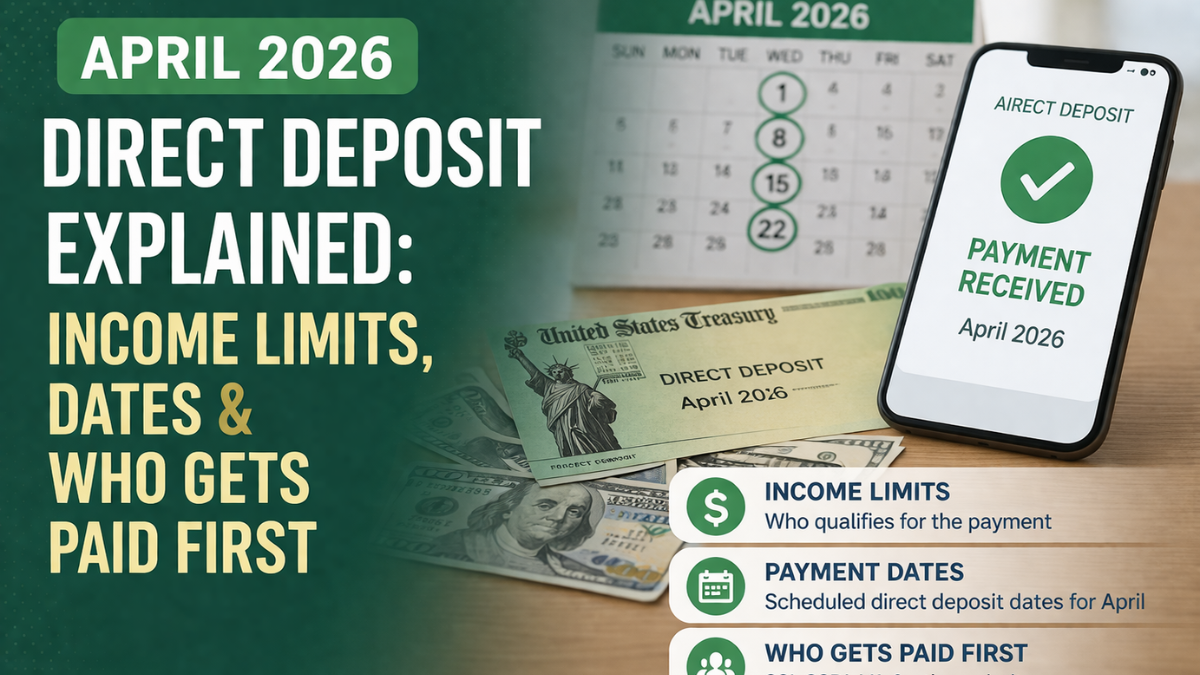
According to the Social Security Administration (SSA), the five payment dates for April 2026 are fixed and firm:
- April 1 – SSI recipients
- April 3 – Pre-1997 beneficiaries and dual recipients
- April 8 – Birthdays between the 1st and 10th
- April 15 – Birthdays between the 11th and 20th
- April 22 – Birthdays between the 21st and 31st
That’s it. No surprises. If your payment is scheduled for one of those Wednesdays (or for April 1 or 3), that’s the date you can expect your direct deposit to arrive.
Who Gets Paid First — and Why
The payment order isn’t random. The SSA uses a structured, tiered system to spread out distributions and prevent bottlenecks in the banking system.

SSI Recipients: April 1
Supplemental Security Income (SSI) recipients are always first. SSI supports older adults, people who are blind, and individuals with disabilities who have limited income and resources. Because SSI is not tied to work history, it operates on a separate funding and payment track.
Pre-1997 Beneficiaries and Dual Recipients: April 3
If you began receiving Social Security benefits before May 1997, or if you receive both SSI and another Social Security benefit (like retirement or SSDI), your payment arrives on the third of the month — April 3 in this case.
Birthday-Based Schedule: April 8, 15, and 22
The birthday-based system was introduced by the SSA in May 1997. Your day of birth — not the year — determines which Wednesday you’re paid:
- Born on the 1st–10th? Your money arrives April 8.
- Born on the 11th–20th? Expect April 15.
- Born on the 21st–31st? Your payment date is April 22.
For example, if your birthday is March 7, you’re in the first group. If it’s November 25, you’re in the last group. The year you were born plays no role — only the day of the month matters.
How Much Will Your April 2026 Check Be?
Thanks to the 2026 cost-of-living adjustment, most beneficiaries are receiving more than they did in 2025.
The COLA for 2026 is set at 2.8%. According to Kiplinger, this translates to roughly $56 more per month for the average retiree, bringing the average monthly retirement check to approximately $2,071. As of February 2026, the SSA’s own Monthly Snapshot put the average retirement benefit at about $2,076.
Here’s a quick breakdown of key benefit figures for 2026:
| Benefit Type | Average Monthly Amount |
|---|---|
| Social Security Retirement | ~$2,071–$2,076 |
| SSDI (Disability Insurance) | ~$1,500+ |
| SSI (Individual) | $994 (federal max) |
| SSI (Couple) | $1,491 (federal max) |
The average federally administered SSI payment in January 2026 was $737 per month, which is lower than the maximum because many recipients also receive other income that reduces their SSI benefit.
Income Limits: Who Qualifies and Who Could Lose Benefits
This is where things get a little more technical — but it’s crucial to understand if you’re currently receiving benefits or considering applying.
SSI Income Limits
SSI is a needs-based program, meaning your income and assets must fall below specific thresholds.
- To qualify in 2026, a single individual generally must earn less than $2,073 per month from work. For married couples, the threshold rises to $3,067 per month.
- Your resources (like savings and bank accounts) must not exceed $2,000 for an individual or $3,000 for a couple.
Not all income counts against you, though. SNAP (food stamp) benefits, certain housing assistance, and some state payments may be excluded from the calculation. Gifts and irregular income can also sometimes be excluded if they meet specific SSA criteria.
SSDI Substantial Gainful Activity (SGA) Limits
For Social Security Disability Insurance (SSDI), the key income threshold is called Substantial Gainful Activity (SGA). If you earn more than the SGA limit consistently, the SSA may determine you’re able to support yourself and could suspend or end your benefits.
For 2026, the SGA limits are:
- Non-blind SSDI recipients: $1,690 per month
- Statutorily blind SSDI recipients: $2,830 per month
These figures are up from $1,620 and $2,700 in 2025, respectively, reflecting adjustments tied to the national average wage index.
Trial Work Period: SSDI recipients who want to test their ability to return to work have a safety net. During a Trial Work Period (TWP), you can earn above $1,210 per month for up to nine months within a 60-month window and still receive your full SSDI benefit. After that, the SSA will assess your earnings against the standard SGA limit.
Earnings Limits for Retirement Beneficiaries Still Working
If you’re collecting Social Security retirement benefits but haven’t yet reached full retirement age (FRA) and are still working, your benefits may be reduced if your income exceeds certain thresholds:
- Under full retirement age all year: Benefits are reduced by $1 for every $2 you earn above $24,480 annually.
- In the year you reach FRA: Benefits are reduced by $1 for every $3 you earn above $65,160 (counting only months before your FRA).
- Once you reach full retirement age: There is no earnings limit. You keep every dollar.
Direct Deposit Timing: When Does Money Actually Hit Your Account?

The SSA sends payments on the scheduled date, but your bank determines exactly when the funds become visible in your account.
Most direct deposits from the SSA post between midnight and 9:00 a.m. Eastern Time on the payment date. Some banks and credit unions — especially online banks — process ACH (Automated Clearing House) transfers early and may make funds available as soon as midnight the night before.
Traditional brick-and-mortar banks sometimes take a few more hours. If your deposit hasn’t shown up by the afternoon of your scheduled payment date, that’s when it makes sense to follow up.
What to do if your payment is late:
- First, verify your scheduled date using the SSA’s birthday-based chart.
- Contact your bank or credit union — processing delays at the financial institution are the most common reason for late deposits.
- If your bank confirms they haven’t received the payment and it’s been three or more business days past the scheduled date, call the SSA directly at 1-800-772-1213.
No Bonus Checks in April 2026 — Here’s the Truth
You may have seen online headlines promising “double payments” or “bonus checks” in April 2026. To be clear: the SSA has not announced any supplemental or extra payments for April 2026.
The confusion often stems from how SSI dates are handled. When the first of the month falls on a weekend or federal holiday, the SSA sends SSI payments early — on the last business day of the previous month. This creates the appearance of two payments in one month, but it’s simply a scheduling adjustment, not a bonus.
April 1, 2026, is a standard Wednesday business day, so there is no date shift at all this month.
Paper Checks vs. Direct Deposit: Make the Switch
As of 2026, the SSA now requires all new Social Security recipients to receive payments electronically — either via direct deposit to a bank account or through a Direct Express Debit Mastercard.
If you or a family member is still receiving paper checks, it’s worth making the switch. Paper checks are mailed on the scheduled payment date and typically take three to seven additional business days to arrive, depending on your location. Electronic payments are instant, more secure, and far less likely to be lost or stolen.
You can update your direct deposit information through your my Social Security account at ssa.gov, or by calling the SSA directly.
Quick Tips for Managing Your April Payment
- Verify your schedule now. Log in to ssa.gov or your “my Social Security” account to confirm your exact April payment date and amount.
- Check for SSA notices. Important communications — including overpayment notices — are often posted to your online account before a paper letter arrives.
- Know your income limits. If you’re working part-time while receiving SSDI or SSI, stay aware of your monthly earnings to avoid crossing the SGA or eligibility thresholds.
- Plan your bills around your date. If your payment arrives April 22, don’t schedule rent or utility autopayments for April 20.
Summary
April 2026 Social Security direct deposit payments are distributed across five dates: April 1 (SSI), April 3 (pre-1997 and dual recipients), April 8, April 15, and April 22 (staggered by birthday). There are no federal holidays disrupting this month’s schedule. The 2026 COLA of 2.8% means most recipients are receiving slightly higher checks than last year, with average retirement benefits around $2,071 per month and maximum SSI at $994 for individuals.
Income limits for SSI, SSDI, and working retirement beneficiaries remain in effect and have been updated for 2026. All new recipients must use direct deposit; existing paper check recipients are strongly encouraged to switch for faster, more reliable payments.
FAQs
Q1: When exactly is the first Social Security payment in April 2026?
SSI recipients receive the first payment on April 1. The next group — pre-1997 and dual recipients — is paid on April 3, 2026.
Q2: How do I know which April 2026 payment date applies to me?
Your payment date is based on your birth day. Born 1st–10th: April 8. Born 11th–20th: April 15. Born 21st–31st: April 22, 2026.
Q3: Will I receive a bonus or extra Social Security payment in April 2026?
No. The SSA has not confirmed any supplemental or bonus payments for April 2026. Online claims about extra checks are not verified or official.
Q4: What is the maximum SSI payment for 2026?
The 2026 federal maximum SSI payment is $994/month for individuals and $1,491/month for eligible couples, reflecting the 2.8% COLA.
Q5: Can I still get SSDI if I work part-time in 2026?
Yes, if your earnings stay below $1,690/month (non-blind) or $2,830/month (blind). The Trial Work Period also provides extra flexibility.