Electric Vehicles · India EV Market · 2026
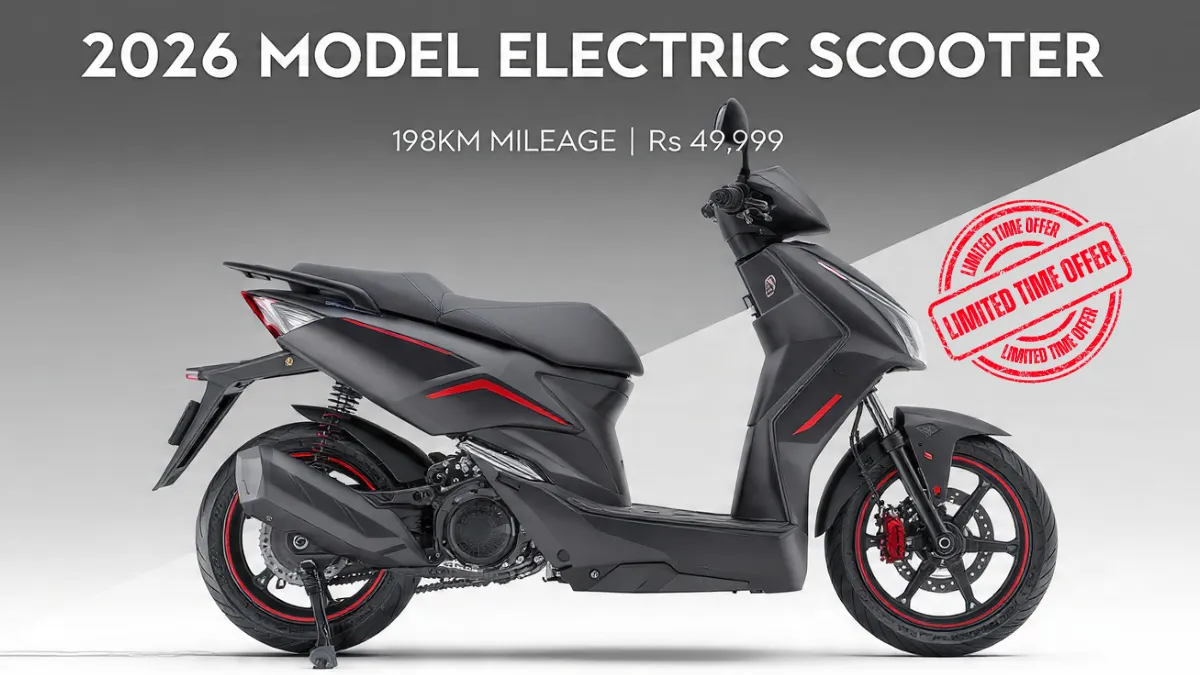
2026 Model Electric Scooter with 198KM Range Launched at Just Rs 49,999 — Everything You Need to Know

India’s electric scooter market just got a compelling new entrant — a 2026-model commuter that reportedly delivers up to 198 kilometers on a single charge, all for under Rs 50,000. Here’s a clear-eyed look at what’s been reported, what’s genuinely impressive, and what buyers should verify before opening their wallets.
A Bold Entry Into India’s EV Revolution
Fuel prices aren’t getting cheaper, and city commuters across India know it all too well. Whether you’re a college student in Pune, a delivery rider in Hyderabad, or an office goer navigating the daily grind in Delhi, the math on petrol has been painful for years. That’s exactly the gap a newly reported 2026-model electric scooter is targeting — and it’s doing so with a specification sheet that, if accurate, is nothing short of remarkable for its price bracket.
According to multiple reports circulating after the EICMA 2025 motor show in Milan, a new electric scooter has been unveiled with a claimed range of 198 kilometers per charge, priced at just Rs 49,999 (ex-showroom). Pre-bookings have reportedly opened in select Indian cities for a token amount of Rs 999, with nationwide dealership rollout expected soon.
Key Specifications at a Glance
| Feature | Specification |
|---|---|
| Claimed Range | 198 km (single charge, ideal conditions) |
| Battery | 3.5 kWh Lithium-ion |
| Motor | 2000W Hub Motor |
| Top Speed | 65 km/h |
| Standard Charge Time | 4–5 hours (full charge) |
| Fast Charge | ~2 hours to 80% |
| Riding Modes | Eco, Standard, Sport |
| Display | Full Digital (Speed, Battery, Trip) |
| Connectivity | Bluetooth / App (select variants) |
| Safety Features | Anti-theft alarm, Geo-fencing |
| Extras | USB charging port, Reverse mode |
| Ex-Showroom Price | Rs 49,999 |
| Pre-booking Amount | Rs 999 |
| Warranty (Reported) | 3-year battery warranty |
What Makes the 198KM Range So Significant?
Range anxiety is the single biggest reason many potential EV buyers in India hold back. Most affordable electric scooters in the sub-Rs 60,000 segment offer a real-world range of 60–90 kilometers — enough for a day’s city riding, but not much buffer beyond that. A claimed 198 km fundamentally changes the conversation.

To put it in perspective: the distance from Gurugram to Jaipur is roughly 270 km. While you’d still need one charging stop on that trip, the scooter’s range is more than sufficient to handle 2–3 days of typical urban commuting (averaging 25–40 km/day) on a single charge. That’s genuinely liberating for daily riders.
The Motor and Performance: Built for Urban India
The scooter uses a 2000W hub motor — a configuration where the motor is mounted directly inside the wheel hub. This design eliminates the need for a chain or belt drive, reduces maintenance requirements significantly, and delivers smooth, immediate power delivery from a standstill. In bumper-to-bumper city traffic, that responsiveness is genuinely useful.
The top speed of 65 km/h is calibrated for urban use. It won’t win any drag races, but it’s well-suited for navigating most city roads and arterial routes. Three riding modes let you choose between stretching your battery (Eco, capped at ~45 km/h), balanced everyday riding (Standard), and a more spirited response (Sport) when you need to merge or accelerate quickly.
Smart Features That Add Real Value
App Connectivity
Track battery level, location, and riding stats via a connected smartphone app on select variants.


Geo-Fencing & Anti-Theft
Set virtual boundaries for your scooter and receive alerts if it moves without authorization.
USB Charging Port
Keep your phone powered up while you ride — a small but genuinely practical everyday feature.
Reverse Mode
Incredibly useful for parking in tight urban spaces. Electric motors make this easy to implement.
LED DRL Headlamp
Daytime running lights improve visibility significantly, especially at dusk and in foggy conditions.

Full Digital Display
Real-time readouts for speed, battery percentage, trip distance, and riding mode at a glance.
The Price Point: How Does It Stack Up?
At Rs 49,999 (ex-showroom), this scooter sits in a fiercely competitive but underdeveloped segment — affordable EVs with genuinely long range. For comparison, established models like the Ola S1 X (2 kWh) start around Rs 79,999, while the Hero Vida V1e is priced above Rs 1 lakh. Even budget-oriented options like the Bgauss A2i carry a higher sticker price for similar or lesser range.
On-road costs will be higher than ex-showroom. Expect to add approximately Rs 5,000–8,000 for registration, insurance, and handling charges, bringing the all-in cost to roughly Rs 55,000–58,000. Even so, that’s an extraordinary value proposition if the battery and motor deliver as advertised.
Additionally, buyers may be eligible for state-level EV subsidies under schemes tied to the FAME-II framework or successor programs, which could reduce the net outlay further. Check your state’s EV policy for current incentives.
What It Costs to Run (vs. Petrol)
The real long-term win with any EV isn’t the purchase price — it’s the running cost. A petrol scooter averaging 50 km/l and covering 40 km daily would consume roughly 0.8 liters of fuel per day. At current petrol prices of around Rs 100/liter, that’s Rs 80/day, or about Rs 2,400/month.
An electric scooter covering the same distance on a 3.5 kWh battery (getting, say, 180 km/charge) uses roughly 0.78 kWh per day. At an average domestic electricity rate of Rs 7/unit in India, that’s under Rs 6 per day — or about Rs 180/month. The monthly savings alone can exceed Rs 2,200, meaning the scooter largely pays for itself within two years of switching from petrol.
Practical Tips Before You Book
- Visit a physical dealership to test ride before committing — range and performance claims should be verified in conditions that match your typical route.
- Confirm the warranty terms in writing: battery warranty, motor warranty, and general vehicle warranty should each be clearly stated.
- Check whether your state offers EV subsidies and whether this model qualifies — this can meaningfully reduce your effective cost.
- Ask about after-sales service network density in your city; a wide range claim means little if charging support and spare parts are hard to find locally.
- Use Eco mode for routine commuting to consistently hit better real-world range figures, and reserve Sport mode for moments when you genuinely need the responsiveness.
- Install the companion app (if available) before your first long ride — geo-fencing and battery tracking are most valuable when set up in advance.
The Bigger Picture: India’s EV Momentum in 2026
This scooter isn’t arriving in a vacuum. India’s electric two-wheeler market has been growing at a dramatic pace, with over 1 million units sold annually and projections pointing sharply upward. Brands like Ola Electric, Ather Energy, TVS, and Bajaj have driven awareness and acceptance. Infrastructure — public charging points, home charging stations — is expanding steadily, if unevenly across geographies.
What a Rs 49,999 electric scooter with 198 km range represents is a potential tipping point for Tier 2 and Tier 3 cities, where petrol costs hit harder and income constraints are steeper. If the product delivers on its promises, it could meaningfully accelerate adoption in markets that established EV brands have yet to fully serve.
Summary
A new 2026-model electric scooter showcased at EICMA 2025 has generated significant attention with a claimed range of 198 km per charge and an ex-showroom price of just Rs 49,999. The scooter runs on a 3.5 kWh lithium-ion battery paired with a 2000W hub motor, tops out at 65 km/h, and includes features like Eco/Standard/Sport riding modes, a digital display, app connectivity, anti-theft geo-fencing, reverse mode, and a USB charging port.
Real-world range under normal Indian riding conditions is likely to be closer to 150–170 km, which is still exceptional for this price bracket. Pre-bookings are open at Rs 999 in select cities. Potential buyers should confirm the manufacturer identity, verify specifications at a dealership, and check state EV subsidy eligibility before committing.
If the scooter’s claims hold up in the real world, it represents one of the most compelling value propositions in India’s fast-growing EV two-wheeler market — and a meaningful step toward making electric mobility accessible to everyday commuters at every income level.